Friday, April 17, 2009

Angels Watching Over Me

I’ve never really thought that much about angels. I guess I was raised in a church that left the impression with me that while God used to do miracles, he now does Bible. And if you aren’t going to do miracles, then you don’t need a bunch of angels hanging around. I assumed that the reason the angles are always around the throne worshiping in Revelation is that God really doesn’t need them much any more, so they have extra time to worship. Of course, the whole book of Revelation has angels buzzing all over the place. I just never thought about angels.

Well, guess who is teaching a class on angels on Wednesday nights? Yep. In fact, the main reason I chose to teach this class was that I really did need to think and study some about the topic. So I might as well share what I learn... right? In other words, take the guy who is totally ignorant on the subject and let him teach.

The first thing that struck me—angels are all over the Bible. I mean they are all over it (how did I miss that?) The English word “angel” appears 305 times in the NIV— Revelation (77x), Luke (24x), Acts (22x), Zechariah (20x), Matthew (19x), Judges (17x), Genesis (15x), Hebrews (13x). And that’s not counting cherubim, seraphim, heavenly hosts or a host of other words used for angelic beings. Whereas 63 of 73 uses of the word “demon” appears in the gospels, the appearances of angels are spread all throughout the Bible.

And they appear doing a lot of different things. The word “angel” in both Hebrew (malak) and Greek (angelos) means “messengers.” Angels are God's messenger service, and a lot of familiar angel stories indeed have angels bearing messages... like announcing the birth of Jesus and telling Lot to get out of Dodge (actually it was Sodom). But angels are said to do a lot of other things as well—
  • Provide protection during the exodus (Exo. 14:19)
  • Fight and defeat the Canaanite enemies (Exo. 33:2)
  • Prevents Balaam from going where he should not (Num 22:32)
  • Rescues Daniel by shutting mouth of the lions (Dan 6:22)
Angels are messengers, but they are also ministering spirits that serve us (Heb 1:14). I don’t know that I have ever received a message from an angel, but somehow angels are there to serve those who believe. And when the church assembles to worship, somehow we are there with a whole bunch of angels (Heb 12:22). I don’t know exactly how angels do their ministering thing, but somehow it makes be feel better that they do.

So maybe Amy Grant was right after all?

Thursday, April 16, 2009

The End of Christian America

Newsweek reported this past week on a recent study that revealed a decline in religious influence in our country. The title of the article was as catchy as it was overstated—“The End of Christian America.” The message of the study the article stresses is that the number of Americans who claim no religious affiliation has nearly doubled since 1990, rising from 8% to 15%. The article points to “an old term with new urgency: post-Christian.” Post-Christian means that we live in a world (or country) where there is no longer a Christian presumption.

The American Religious Identification Survey (ARIS) covered by Newsweek found that the percentage of self-identified Christians has fallen 10% points since 1990, from 86% to 76%. By contrast, the Jewish population is 1.2% and Muslims are 0.6%. The article also pointed out that “the number of people willing to describe themselves as atheist or agnostic has increased about fourfold from 1990 to 2009, from 1 million to about 3.6 million.” So we have twice as many atheists as Episcopalians in the United States.

So... what do you think when you hear people talking about “The End of Christian America” or the "Rise of Post-Christian America?" What is your first and best response when people suggest that the political and social influence of Christianity on our country is on the wane? Would it surprise you to hear some believers responding with, “It’s about time?” Some believers point out that one of the great enemies the kingdom of God has had to face in recent years as been the allusion that it (God’s kingdom) fits in so well with the kingdoms of the earth. In a recent blog, Greg Boyd lists 6 reasons why the church should not weep too much over the demise of American Christianity. The bullets below are summaries of his points; read his blog for the full discussion—
  1. America has never been (or will be) a “Christian” nation. All nations of the world are ruled by Satan (Lk. 4:5-7; 2 Cor. 4:4; I Jn. 5:19). No earthly country is capable of being Christian in the sense of loving enemies, doing good to those who mistreat it or blessing those who persecute it (Lk. 6:27-35). By applying the term “Christian” to America, we’ve watered down the meaning of Christian.

  2. Most American’s who identify themselves as “Christian” to pollsters actually mean they are “American” in terms of core values and lifestyle choices. A majority of people assume they are “Christian” by virtue of being American or because they prayed a certain prayer or go to Church once a year. If fewer people see themselves as “Christian,” this is one less illusion we have to confront as we invite folks into the Kingdom of God.

  3. If Evangelicals lose all their political clout, we may be less tempted to lust after political power, which means we may have one less distraction from actually doing what God called us to do — namely, manifesting God’s reign by how we humbly live, love and serve.

  4. The Kingdom has always (only) thrived when it was on the margins of society. The Kingdom is, by its very nature, a “contrast society.” If Christians lose all their power and position in society and become marginalized, this can’t help but be good for the Kingdom. If Christians become persecuted, it likely will be even better.

  5. American as “Christian nation” was never deeper than the thin veneer of a shared civic religion. Many think being “Christian” is focused on preserving this civic religion (prayer in school, 10 Commandments on government buildings, a “Christian” definition of marriage within our government, etc.). This veneer of civic religion causes many Jesus followers to not notice the many foundational assumptions that permeate American culture are diametrically opposed to the values of the Kingdom.

  6. If Jesus followers are more marginalized by culture, that may drive us together in fellowship and help us to finally get it that the Kingdom of God is inherently communal. It is very difficult for many to embrace radical Kingdom community when we can get along very well (by American standards) without it. The demise of American Christianity would serve us well by stripping us of the privilege of individualistic living.
Peter addressed the Christian to whom he wrote as "God’s elect, strangers in the world" (1 Pet 1:1). He later called them "aliens and strangers in the world" (1 Pet 2:11). The Hebrews writer says that one of the characteristics of people who live by faith is that they see themselves as "aliens and strangers on earth" (Heb 11:13). Those who live in the kingdom of God will never quite fit into this world. We are called to follow Jesus "outside the camp" of this world "bearing the disgrace that he bore" (Heb 13:13). The more we fit into the power structures of this world, the less we are living the principles and power of the kingdom of God.


Tuesday, April 14, 2009

A Special Day

OK, so I should have written this reflection yesterday. But Lynn was off yesterday and we spent the day together. It may be OK for me to take my time to blog, but its not OK to take her time!

What a day we had Sunday! We had more people here for worship than we had places to put them-- we literally put out every chair we had and still didn’t have enough room for all. The singing was outstanding even though we did several less-than-familiar songs. We were so full that we had to move people off the front row to make space for T.J. and Kellie when they came forward to be baptized. Of course, seeing them confess their faith and have their Daddy baptize them put an exclamation point on our day of worship. Well, that and me forgetting to turn my mike off and then singing “Rabboni” along with the praise team!

We had a lot of people stay for the egg hunt and the pot luck. I have never seen so much food… nor tried so diligently to make large portions disappear. All in all, this was a great day. It was a long day, but a great day.

A quick check through my old sermons (something I can only rarely bring myself to do) revealed that about half of my sermons on the resurrection were preached on or near Easter Sunday. It hasn’t been all that long that have been comfortable enough with "Special Days" to make a big deal on Easter, but we’ve always been open to sermons on the resurrection. When I was in school, one of my professors suggested preaching on the birth of Jesus on Easter and His resurrection on Christmas. That always smacked of being a bit of a wise guy to me… that’s why I liked it! I am glad that we aren’t as paranoid of special days and “traditions” as we used to be. A special focus service on the resurrection can be helpful, and Easter just seems to be the best time to do that. Yesterday was a good example.

Thursday, April 09, 2009

How to Stop an Indian Attack

When I was a kid, it was just expected that little boys would play “Cowboys and Indians.” This was in the days before political correctness… or historical correctness! There is an old saying, “History is written by the victors.” Or Hollywood! Movie and TV westerns created many myths—like scalping being invented by indigenous peoples (they learned it from the French). One of “facts” that I remember from movies is how to thwart an Indian attack-- just shoot the chief. Once the chief is out of the way, then the rest will just stop and give up. Evidently, Native Americans need a leader, so if you can eliminate the chief, the rest will scatter. Of course in the movies, that was usually pretty easy because the chief always rode up front and wore a huge headdress that just shouted, "Shoot me." And then the cowboys always had those magical Winchesters that never ran out of bullets!

The Jewish leaders subscribed to this TV western myth when it came to Jesus. They thought that if they could kill Jesus, his disciples would scatter. All they had to do was trump up some charges, pay witness and manipulate the legal process, and both Jesus and his movement would die. When they arrested Jesus, it looked like their plan worked because all the Indians did indeed scatter (Mk 14:50). In fact Mark tells of one young man (maybe himself) so intent on getting way that he ran right out of his clothes (Mk 14:51). They surely thought that the public, horrific execution of Jesus had ended his movement and their problems.

Imagine the shock of the Jewish establishment when Christ's movement grew further and faster after his death than it had before. Three thousand responded to Peter’s first sermon... a sermon on the resurrection, “Seeing what was ahead, he spoke of the resurrection of the Christ, that he was not abandoned to the grave, nor did his body see decay” (Acts 2:31). More (5000 men) responded in Acts 3 to a very similar resurrection sermon, “You killed the author of life, but God raised him from the dead. We are witnesses of this” (Acts 3:15). The whole thing was getting out of hand, so the Sanhedrin called in the apostles in an effort to intimidate them into silence. What they got was the very same sermon, “Jesus Christ of Nazareth, whom you crucified but whom God raised from the dead” (Acts 4:10).

Christianity spread because of the message of the resurrection of Jesus Christ. Now first century people were not pushovers when it came to resurrection stories. They were not unsophisticated bumpkins or uncritically superstitious louts who would fall for anything. In fact, many Jews (like the Sadducees) didn’t believe in any resurrection any where at any time. Greeks were as likely as people today to see resurrection talk as a joke (they “sneered” in Acts 17:32). The idea of Jesus’ resurrection was not an easy first century sell at all! But that story spread like wildfire and filled the earth largely because the people who preached it were so radically changed by the message.

What keeps Christianity from spreading today is not that the message of the resurrection sounds too weird to modern, critical ears. The problem may be that those of us who believe it simply are not as changed by it not obsessed with it as were the first believers. The problem is not with the message of Easter; the problem is us.

Wednesday, April 08, 2009

On Sinking Ships

By a wide margin, the highest grossing motion picture of all time is Titanic. Well, that makes sense. It is really two movies in one— a mushy love story sandwiched inside a disaster flick, a soap opera with a body count. It is the story of Jack, a fun-loving, self-absorbed penniless artist and Rose, a sad, suicidal socialite who is being forced to marry a man whom she did not love. These two people are about as different as night and day, but the boy from steerage accidentally meets the girl from the first class, and they fall immediately and deeply in love. Unfortunately, they don’t live happily ever after; after all, this is the Titanic. During the sinking of the great ship, Jack dies so that Rose can live.

Marc Newman uses the movie Titanic to make a point to college students about the nature of true love. The question Newman asks his students to debate in class is this— “Given what we know of Jack’s character, do you think that he and Rose would have had a successful marriage?”
When push came to shove, Jack was able to make the single grand gesture to the beautiful woman, and give his life that Rose might have a chance to live. But could Jack, would Jack, have married Rose? And if so, could he have put up with the daily self-denials that are required to maintain a marriage over fifty years, when his lover is no longer young and nubile? G.K. Chesterton commented that many people say that they will do anything for love, except sacrifice for it.
Is it possible that dying for the one you love in a blaze of glory is not nearly as difficult as living and sacrificing for them daily? I think Newman is on to something there. The greatest barrier we face in our relationships in marriage, in the church and with God is the daily grind, the ongoing continuing sacrifice of bending and yielding our wills to that of another. The reason so many relationships are sinking ships is that we refuse to really die to self.

Sunday, April 05, 2009

Good News and Bad News

The Good News: When I filled out my brackets before the NCAA olledge basketball tournament began, my Final Four were... well, never mind, that's not important now. But my final two teams were North Carolina and Michigan State playing in the in the championship game. Tomorrow night, North Carolina will play Michigan State in the championaship game. They could have saved a lot of trouble and drama if they would have just asked me! Oh, just so you know, I have North Carolinia winning it all.

The Bad News: While I'm writing this, Turbo Tax is installing itself on the computer. Tomorrow is the day I do my taxes. Well, unless an emergency comes up... like I have to wash my car or something. But then I'll have plenty of extra time since I don't have to actually watch the basketball game.

Friday, April 03, 2009

Meeting God at the Shack

I finally got around this week to reading The Shack, by William P. Young. The book was published in 2007 and spent much of 2008 on the best seller lists despite a marketing budget of about $300. Young wrote the story to explain his faith to his children, and it grew from there first into a screenplay (I hope they do make the movie!) and then into the novel. Much of the book is a theological conversation between Mack, the main character, and God. Their conversation is hung on what happens earlier in the novel.

Four years earlier, Mack (short for Mackenzie) takes his children on a camping trip at the end of which his youngest, Missy, disappears. A frantic search fails, and it is discovered that Missy was abducted by a pedophile serial killer known as “The Little Ladykiller” who had abducted other little girls at various parks. None of the bodies were ever found, but at each abduction scene, the killer leaves a ladybug pin, adding a dot to the ladybug to represent the next girl. Missy was the fifth dot, and her bloody dress was found inside an old “shack” (hence "The Shack") found deep inside the park. Mack is devastated by his loss and grief, and his life is dominated by what he calls “The Great Sadness.”

Mack mysteriously received a note inviting him back to the shack for a weekend, a note signed by “Papa,” his wife’s pet name for God. After internal debate and borrowing a pistol from a friend (the note could be from the killer), he goes to the shack. The killer isn’t there— but God is. God appears in the novel as Papa, a rotund, jolly African-American woman. Jesus is a young Jewish man with a big nose and dressed as a carpenter. Finally there is Sarayu, an Asian woman shimmering in light and wind that represents the Holy Spirit. Most of the rest of the book are conversations between Mack and the Trinity and the Trinity and Itself.

God as a black woman? (If it bothers you that God is not white, that can be a whole other blog). Mack’s father was a abusive man church deacon drank excessively and beat his wife and family relentlessly. Mack couldn’t relate to God as father until we worked through this anger with his earthly father. At the end of the book, God does show up as an old white man with a flowing beard to that represent Mack’s healing and readiness to accept God as heavenly Father. So Mack spends much of the book feeling a bit distant from Papa but is instantly drawn to Jesus.

Are there theological problems with the book? Well, duh! Much of the book revolves around the relationship of the Trinity with Itself as a model for human relationships. Trying to explain Trinity is impossible; trying to embody it characters in a story is not any easier! The other underlying issue of the book is explaining the so-called “Problem of Evil,” not exactly an easy nut to crack. The book does flitter on the edge of universal salvation and there is no real handling of God’s righteousness and judgment of sin (sin is seen as its own punishment). The book is built on an “Open Theism” where God limits His foreknowledge so that he can enter in relationship with us in the now. (See the review by Greg Boyd). Many of the negative reviews I’ve read are from Calvinists, and I can understand why they don't like it. The God in “The Shack” is not a God who determines all events beforehand and who has the sheep and goats predestined before creation. Papa is a God who created human free will and who seeks relationship with us despite our often wrong-headed free-will choices... and He works through those choices. If you want some deeper theological insights on the Shack, read this blog and this blog by my old camp buddy John Mark Hicks.

OK, as Roger would point out, I really didn’t READ the book; I listened to it as an audiobook, mostly while painting our utility room. I was up until almost 1:00 a.m. Tuesday night, not because U was ionto the painting, but because I simply didn’t want to stop listening to the book. The story went straight to my heart, and I must confess several points of putting down my brush, sitting on the ladder and laughing and crying all at the same time (OK, my eyes teared-up; I don’t really cry). The story grabbed my heart with a fist of grace. It reminded me (and I can forget) of a God who says, “I am especially fond of you.” Church folks like me can sometimes lose God amid the rules, liturgy, doctrines, services, sermons, committee meetings and the like that is church. Sometimes we need to be subtly reminded of what faith is all about. And this book was about as subtle as a 2x4 upside the head.

At one point, Mack asks Jesus at one point if all roads lead to Him (again skittering on the edge of universalism). Jesus responds, “Most roads don't lead to anywhere. What it does mean is that I will travel any road to find you.” Wow! Jesus really did that, didn’t He? In explaining why so many evil things happen in the world despite Divine power and presence, Papa (God) says,
Mack, just because I work incredible good out unspeakable tragedies doesn't mean I orchestrate the tragedies. Don't ever assume that my using something means I caused it or that I need it to accomplish my purposes. That will only lead you to false notions about me. Grace doesn't depend on suffering to exist.
I said something like that in a sermon last month... just not as well. Evil is the result of man’s evil free choices, choices that God does not overrule because He loves us so much he respects our choice.

Are there problems with Young’s view of God? Sure. The book is ultimately metaphor, and any metaphor falls apart when it’s pushed too far. I’m preaching through Amos right now, and the God of Amos is not the jolly Papa but a hungry Lion ready to tear His rebellious and wicked people to pieces. Aslan the Lion, the Christ-figure in C.S. Lewis's Narnia, has teeth. When you are dealing with God, it is best not to forget the teeth!

The reviews I’ve read of the book are of two types—those who absolutely loved it were drawn to God by it AND those who hated it and saw in it false theology and religious error. Put me squarely in the first camp (with an skinted eye on the second). Put it this way, I’ve ordered 3 more copies—one for each of my girls and another to just to have around to loan out. To borrow a line from Jim McGuiggen, “Everyone should be forced to read The Shack… if they want to.”

Thursday, April 02, 2009

Two Masters

A couple of years ago, I wrote a blog on Ann Holmes Redding has been an Episcopal priest for now almost 20 years and then also embrace Islam. She was defrocked Wednesday when she completed her conversion as a Muslim. She was upset that she was removed from her position as priest because she sees no conflict between Christianity and Islam.
Both religions say there's only one God and that God is the same God. It's very clear we are talking about the same God! So I haven't shifted my allegiance.
She seems to sincerely believe that it is perfectly logical to be both and that she can't understand why some people want her to choose.
The church interprets my being a Muslim as 'abandoning the church' and that [there] comes an understanding that you have to be one or the other... It simply hasn't been my experience that I have to make a choice between the two.
I would suggest that she did make a choice. Jesus said, "I am the way and the truth and the life. No one comes to the Father except through me." You cannot say that there is one God and "Mohammad is His prophet" and then at the same time accept Jesus as Lord. You can't serve two masters.

That seems pretty straightforward and simple. If you become a Christian, you can't be a Muslim. And visa-versa. So I'm not pushing the profound meter too dramatically this morning (as if I ever do). But what about being a Materialist Capitalist and being a Christian? The "master" we must choose Jesus over in Matthew 6:24 is MONEY. The God we can't worship if we worship Jesus is those green (and now brown) things with pictures of dead presidents. I wonder if God sees our obsession with materialistic prosperity while also being Christian as just as bizarre as when we see someone who claims to be both Muslim and Christian. We really do have to choose who is Lord... and them follow Him. Or it.

Wednesday, April 01, 2009

Stand Still

Do you have a boring job? I love my job, but I have to admit that sometimes I get sleepy at work. The other day I had to quit working on the sermon I was writing and get up and move around (a much needed straightening of my office). Its not a good sign when you fall asleep writing a sermon; it likely means that people will fall asleep listening to it! If you fall asleep at your job, here are some good excuses that you can use on your boss--
  • "It’s OK, I’m still billing clients."
  • "They said at the blood bank this might happen."
  • "Whew! I must have left the top off that White-Out!"
  • "I wasn’t sleeping—I was meditating on our vision statement."
Falling asleep may not indicate that our job is boring; it may just be reminding us that we aren’t getting enough sleep. I’m told that the average adult needs 8 to 8.5 hours of sleep each night and teens 9 to 9.5 of sleep! Do you know anyone who actually gets that? I usually get about 6.5, so I’m an hour or so in deficit. Last night it was a lot less because I was up until almost 1:00 a.m. painting. Actually, I kept painting because I was listening to The Shack audiobook, but I’ll write about the book another time. (If you’ve ever wondered whether you can paint, laugh and cry at the same time, you can).

Our culture doesn’t rest well. Some cultures take 2 hours in the middle of the day for lunch and a nap ("siesta" in Hispanic countries, "bhat-ghum" in parts of India or "xiuxi" in China). If we had two hours off in the middle of the day, we would be invariably work out, run errands, go shopping… or maybe get a part time job! We just don’t rest well. When we take a vacation, we need a vacation to rest up from the vacation. Mondays are, well Monday, because we rush so much during the weekends that it wears us out.

It has been a long time since we made the mistake of seeing Sunday as “the Sabbath.” Technically, Sunday isn’t the same as the Sabbath, but maybe we would be better off if we treated in that way. Maybe we need to spend more time quieted before God. Psalm 131 says--
1 My heart is not proud, O Lord,my eyes are not haughty;
I do not concern myself with great matters or things too wonderful for me.
2 But I have stilled and quieted my soul; like a weaned child with its mother,
like a weaned child is my soul within me.
3 O Israel, put your hope in the Lord both now and forevermore.

Tuesday, March 31, 2009

Line in the Sand

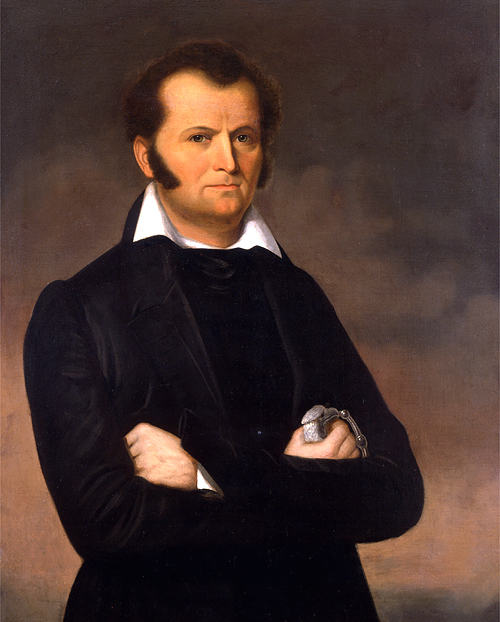
Jim Bowie was the inventor of the heavy fighting blade known as “the bowie knife.” What many don’t know about Bowie is that he was also a card cheat, slave trader, and swindled people in land deals. He also fought duels. He killed a man in near Natchez, Mississippi, in 1827 in which he literally brought a knife to a gunfight. So Bowie spent much of his life on the run.

He ended up in Texas as an officer in charge of the garrison at San Antonio… until it was learned that he was never in the army. Col. William Travis took over as commanding officer, but the two came to share leadership when they found themselves together two years later at a little church outside San Antonia called “The Alamo.” It was there that Bowie stopped running.

When it became obvious that their cause was hopeless, Travis drew a line in the sand with his sword asking all who were with him and with Texas to step across the line. Everyone knew that to stand their ground in the Alamo meant certain death. Jim Bowie, confined to his bed by tuberculosis, had four of his men carry him, bed and all across Travis’ line. Jim Bowie stopped running at the Alamo.

This is apparently where we get the expression, “to draw a line in the sand.” When we draw a line in the sand, we make a commitment, we take a stand. To draw a line in the sand is to make commitment where there is no giving up and there is no going back.

Paul told the Romans that baptism was their line in the sand. They could not “go on sinning so that grace may increase” (Rom 6:1). I don't think I have really ever heard someone saying that in so many words, “God likes forgiving sins; I like sinning. What a country!” Most Christians believe sin is serious business that should be avoided. But many Christians also believe that grace somehow makes sin somewhat less serious. After all, nobody is perfect! The sin that was such an ugly, monstrous beast has somehow been domesticated because we understand all this grace stuff. Sometimes we act as if sin doesn’t matter quite so much anymore.

Paul didn't think so and he says so quite profoundly in Romans 6. Paul saw baptism as a line in the sand in Romans 6:3-4,
Or don’t you know that all of us who were baptized into Christ Jesus were baptized into his death? We were therefore buried with him through baptism into death in order that, just as Christ was raised from the dead through the glory of the Father, we too may live a new life.”
In baptism, we participate in the death, burial and resurrection of Jesus. In baptism we die to sin. Paul doesn’t say this to give us argument to prove the essential nature of baptism. He assumes baptism (a strong argument in itself) to drive home the point that we made a commitment when we were baptized. We drew a line in the sand and burned our bridges (how’s that for mixing metaphors?). We cannot continue to live in sin because Jesus died to forgive us and we died with him. Yes, He was raised and so are we raised. But we were raised to live “a new life.

Grace should not let us get more comfortable with sin. No, grace points us to the terrible price that was paid to free us. Baptism is our line in the sand; we crossed over and we can't go back.

Monday, March 23, 2009

Monday, Monday

For awhile there, I was on fire picking teams in the NCAA tournament, but I cooled off in a hurry. If a couple of the squeakers would have just gone the other way... I do have 7 of my Elite-8 still alive-- I really thought Texas would beat Duke. But don’t tell Angelynn; she is this huge Duke fan. I don't know when she became such a Duke fan, but it was sometime before she was 7. Arkansas beat Duke for the 1994 national championship and she didn't speak to me for two weeks (OK, I might have rubbed it in a little).

I finished up my sermon series yesterday entitled “Old-New Questions.” These were questions to which everyone once knew the answer. But the world changed and people change, and now the old questions are new again. You can see the questions and the sermons themselves at my sermon page. One of our members said yesterday that she looked forward to finding out what question I was going to cover each week, kind of like watching a TV series. She was a little miffed that yesterday was the season finale without having any advance notice. Maybe I should have had a cliffhanger.

I made a mistake the other day and read an article on “How to Have an Effective Blog.” There were 20 points or so on what makes a blog effective. Like I said, it was a mistake to have read the article… although I think I do OK on point #6.

My next sermon series is on the book of Amos. I haven’t chosen a title yet, but I’m thinking maybe something like “The Cows of Bashan” or “Let Justice Roll” or maybe “Neither a Prophet nor a Prophet’s Son.” I am open to any suggestions. And I think my next Wednesday night class series is going to be “The Christian and Angels.” Why those two topics? I’ve never preached a series on Amos or taught a class series on angels.

I’m trying hard to think of something else to write about. As soon as I finish this blog, I have to start ripping up carpet to get ready for ceramic tile in our utility room and downstairs bath. There had to be a better way to spend my half-day off!

Thursday, March 19, 2009

Living Faith

Fred Winters was the Baptist preacher who was gunned down two weeks ago during the Sunday morning service at First Baptist Church in Maryville, Illinois. Terry Sedlacek, a 27 year man that the church did not know, walked into services and shot the preacher. He fired 4 times before the gun jammed and two members wrestled him to the ground.

Yesterday, Fred's widow Cindy Winters was interviewed on the CBS Morning Show. Her words were about faith, forgiveness and the love of Jesus. Rather than anger for the man that killed her husband and took her girl's father away, she expresses concern for Sedlacek's parents and that Sedlacek himself would come to know Jesus.


What a powerful witness to living faith in a living God. May God bless this good Christian lady and her girls as they heal from this horrific tragedy and loss. And May God continue to use her witness to bring healing to others.

Wednesday, March 18, 2009

The More Things Change

Five years ago, I referred in a sermon to the “Beloit College Mindset List.” Each August for the past eleven years, Beloit College Here are things about the college freshman of 2008-2009 that you have to know to understand about their world. The list reminds us that people can live in the same neighborhood and not be from the same planet. I have abbreviated the list below for the sake of space… and because I didn’t know what in the world some were about! You can see the whole list here. The list really has changed in five years... because the world continues to change.

  • Harry Potter could be a classmate, playing on their Quidditch team.
  • Since they were in diapers, karaoke machines have been annoying people at parties.
  • Coke and Pepsi have always used recycled plastic bottles.
  • Gas stations have never fixed flats, but most serve cappuccino.
  • Electronic filing of tax returns has always been an option.
  • Girls in head scarves have always been part of the school fashion scene.
  • Universal Studios has always offered an alternative to Mickey in Orlando.
  • Grandma has always had wheels on her walker.
  • WWW has never stood for World Wide Wrestling.
  • The Warsaw Pact is as hazy for them as the League of Nations was for their parents.
  • Clarence Thomas has always sat on the Supreme Court.
  • Schools have always been concerned about multiculturalism.
  • Wayne Newton has never had a mustache.
  • IBM has never made typewriters.
  • There has always been Pearl Jam.
  • The Tonight Show has always been hosted by Jay Leno and started at 11:35 EST.
  • They may have been given a Nintendo Game Boy to play with in the crib.
  • Authorities have always been building a wall along the Mexican border.
  • Lenin’s name has never been on a major city in Russia.
  • Balsamic vinegar has always been available in the U.S.
  • Macaulay Culkin has always been Home Alone.
  • Caller ID has always been available on phones.
  • Green Bay Packers (almost) always had the same starting quarterback.
  • They never heard an attendant ask “Want me to check under the hood?”
  • Iced tea has always come in cans and bottles.
  • Soft drink refills have always been free.
  • Windows 3.0 operating system made IBM PCs user-friendly the year they were born.
  • Muscovites have always been able to buy Big Macs.
  • The Hubble Space Telescope has always been eavesdropping on the heavens.
  • 98.6 F or otherwise has always been confirmed in the ear.

So what’s the point? First, we serve an unchanging and unchangeable God who is the same yesterday, today and forever. Second, the language and life experience of people around us are changing constantly. If we want the people around us to come to know our unchangeable God, then we must constantly change the ways we seek to relate to them. The world and the church of the 1950’s no longer exist. I think I get that. Neither do the world nor the church of the 1990’s exist. I haven’t gotten that one quite so well.

Tuesday, March 17, 2009

No Cussing Club

McKay Hatch was an eighth grader when he started a “No Cussing Club” at his school. Today, the No Cussing Club has 20,000 members in all 50 states and 30 different countries around the world. Hatch has been interviewed on TV by Jay Leno, Dr. Phil, Ryan Seacrest and many more. He has also had death threats, had his web site hacked and his address posted online, and someone even sent prostitutes to his house. But McKay refuses to be intimidated away from doing the right thing.

This worldwide movement began when Hatch just got tired of people cussing around him. He told his friends that “If you want to hang around me, I don’t want to hear cussing. And they stopped, and the idea spread. Hatch says that he wants to next go after violence—“Most fights start with words—cussing at each other and making each other angry.”

Hatch told CNN Nicole Lapin that his club was about treating people with civility and respect. He said, "It's about talking to people with civility like you said, and making people feel good about themselves and talking to people with respect. That all starts with your words and how you choose to use them." Words are far more powerful than we sometimes realize. Words that we toss off as meaningless can impact others in ways we don’t realize. James 3:5-8 says—

5 The tongue is a small part of the body, but it makes great boasts. Consider what a great forest is set on fire by a small spark. 6 The tongue also is a fire, a world of evil among the parts of the body. It corrupts the whole person, sets the whole course of his life on fire, and is itself set on fire by hell. 7 All kinds of animals, birds, reptiles and creatures of the sea are being tamed and have been tamed by man, 8 but no man can tame the tongue. It is a restless evil, full of deadly poison.

The amazing part of the story of “No Cussing Club” story is how it started with one middle school student and has spread all over the world. When we do the right thing, it has an impact on others. Sometimes that impact can be seen. More often, the impact is in small and hidden ways that later “raise a harvest of righteousness” (James 3:18).

Friday, March 13, 2009

The Franchise Agreement

My friend Alan Smith sent me a copy of the "Church of Christ Franchise Agreement" from Jay Guinn's blog "One In Christ."  Since I'm preaching Sunday on the true church and I am also running a bulletin article (from one of my earlier blogs) along the same lines, I thought I would reference this blog as well.  Just in case the other two don't get me in enough trouble, this one surely will. 

Guinn in a (very, very) humorous way suggests a charter that includes all the unwritten rules that many of our churches have operated under for years.  If we're going to have a franchise charter, it's much easier to follow if it's written down, right?  Of course, then that would be a creed which like the denominations, and they're all going to hell (you'll have to read Guinn's blog to get that one).

Tuesday, March 10, 2009

Religious Identification Survey

I guess it is one of those good news, bad news things. According to the recently released “Religious Identification Survey” from Trinity College in Hartford, Connecticut, 75% percent of Americans identify themselves as Christian. Well, 3 out of 4 isn’t bad, right? The bad news is that back in 1990, 86% of Americans identified themselves as Christian. Christianity is loosing ground to other religions, but the biggest reason for this shift is the rejection of religion altogether.  The fasting growing religious identification in the country is nothing at all.

The number of people who consider themselves "born-again" or "evangelical" has increased since 1990.  About 33% of Americans identify themselves as evangelical, and the number of people who are members of “megachurches” has grown from 200,000 in 1990 to 8 million in this most recent survey. What does it suggest that overall church membership is decreasing while membership in megachurches is increasing? It suggests that people are leaving smaller traditional churches for larger ones. That doesn't sound much like church growth.

Factoid: I read recently that membership numbers in the Sothern Baptist Church are greatly skewed by the number of Baptists who are officially members of two churches. They are on the membership books at the church at home where they grew up in while at the same time being members of the larger church where they now attend. It is easy for the numbers reported in surveys to become skewed. I’m not sure we need to panic at this point, but these surveys can be a bit disturbing.

In an interview with CNN, William Donohue of the Catholic League suggested that the growing rejection of organized religion reflected by this survey itself reflects the movement towards radical individualism seen in the last 25 years or so. People have been leaving churches because they don’t want religious authority telling them “thou shalt not” in their moral choices. Donahue says, "Notice they are not atheists-- they are saying I don't want to be told what to do with my life."

Paul said that a time was coming when “people will no longer listen to sound and wholesome teaching. They will follow their own desires and will look for teachers who will tell them whatever their itching ears want to hear” (2 Tim 4:3, NLT). But that was already happening as Paul wrote; he ends his description of “the last days” in 2 Timothy 3 by telling Timothy “Have nothing to do with them” (2 Tim 3:5b). The decay of the influence of the church (if that is what’s happening) in America does not mean the end of the world. What it does mean is that we as Christians must redouble our efforts at living our faith in a way that impacts others.

Wednesday, March 04, 2009

Tuesday Afternoon

I worked at home yesterday all afternoon as I waited for the dishwasher repairman. All they could tell me was that he would be there sometime between 1:00 and 5:00 p.m. So I took all my stuff and worked from home while I waited for him. Well, he showed up at 4:45-- about the time I get often home. So I waited all day for nothing. And it took him 5 minutes to fix the thing

But then I got work done at home so the day wasn't wasted, right? Well, I did get a start on Sunday’s sermon, so that is good.However, my fancy USB drive that I carry around on my key chain, the one on which I saved all my work, literally fell apart or me. The case came complete apart as I removed it from the drive. Not to worry, I duck taped it all back together. I just inserted it into the computer here and the good news is that everything was saved properly. The bad news is that I didn’t get as much done as thought.

On another front, I guess now it is officially official now. Tressa’s little dog Bella is now our little dog Bella. Tressa got her just before Christmas, and we kept Bella while Tressa had an apartment full of company. Two things seemed to have happened during the time we were dog-sitting. First, Tressa got over her “I want a dog to keep me company” stage. Second, Lynn fell in love with the little fluff ball. So we are now the proud owners of a 2 pound Maltese; Tressa took her money and bought a Wii. Don’t tell Bella (or Lynn), but I think I’d rather have the Wii!

Friday, February 27, 2009

Don't Let Go of the Rope!

When I was a kid, Dad borrowed a speed boat from his business partner, and we pulled it down to our cabin on Lake Gaston in Carolina. Actually, it wasn't a cabin but an old burned-out trailer Dad had rebuilt and restored. And it wasn't on the lake but in the vicinity of the lake. But it was our retreat into nature, and the only time this city kid was able to hunt and fish. It was also the only time this (clumsy) city kid ever tried to water ski. Or maybe I should say, it was the time my father tried to kill me teaching me how to ski!

The story goes like this. After unloading the boat and getting a brief lesson on water safety and skiing fundamentals, we were off. My sister went first, and within minutes she was skiing circles around the lake… so I knew that it had to be easy. When my turn came, and I gave the ready sign, and Dad took off with the boat. I came up to my feet like a shot, paused for half a second (if that long), and went right over onto my face. Then the fun really began! Dad pulled me behind that boat for what seemed like ten miles-- UNDERWATER. In all the excitement, I forgot to let go of the rope. In fact, I didn’t know that I could let go of the rope. I’m not sure why Dad kept going-- maybe he wanted to see how long his idiot son would hang onto the rope. So I was dragged along bobbing and weaving, diving and surfacing like a Rebel minnow on fast retrieve. Finally the boat came to a stop and my miserable life was spared. I honestly did not know that I could just let go of the rope.

On December 30, 1977, Lynn walked down one of the aisles (they had two) of the Colonial Heights church building and for some reason pledged to be my wife for as long as we both shall live. I guess I'll never know exactly why she did that, but I thank God that she did. My ship came in that day, but it has not been only smooth sailing all the time. The lake has gotten a bit rough. At times I have made her life as bumpy as my first (and only) skiing lesson. There have been twists and turns, flips and bumps. But we are still going strong. And the reason for that is that, like my skiing experience, we just refuse to turn loose! Letting go is just not an option, no matter how bumpy the ride gets.

My sermon Sunday is on divorce. What was almost unheard of when I was a kid is now commonplace. Put 100 average adult people in a room, and 25 of them will have gone through a divorce. For every 10 marriages in our country, there are 4 (or more) divorces. We have learned at some point that not only is it possible to let go of the rope, in a growing number of life situations, you are basically expected to do so.

The issue of divorce for Christian is a complex one, and my sermon Sunday may muddy the water more than it clarifies. But there is one thing that I know for certain from scripture. God hates divorce. Period. Every time a divorce happens, the will of God and the heart of God are broken. We can spend a lot of time discussing “exception clauses” and “the Pauline Privilege.” We can come to the text looking for loopholes. And we can make the Sermon on the Mount a more restrictive legalistic system than the Pharisaic system Jesus was trying to correct. But what remains clear is that God hates divorce. For those seeking to please God, maybe that should be enough.

Wednesday, February 25, 2009

Fun While It Lasted

I'm back to the ol' grind after a rare weekend (plus a day or two) trip away. Lynn and I spent Sat-Tue with my parents in a Myrtle Beach time share to mark their 60th wedding anniversary. We surprised them with a Baskin-Robbins ice cream cake, which was a real surprise since it said "Happy 60th Birthday." Oh, well, it was the thought that counts. We had a great time visiting with them. It was too cold to get on the golf course, but Lynn and I enjoyed a brisk walk on the beach each day.

I had intended to chronicle our trip on the blog while we were gone. The condo had Wi-Fi, so I took our laptop and was prepared to blog away. What I wasn't prepared for was to pay $3 an hour or $12 a day for the Wi-Fi connection! There was no way that I was going to stimulate the Myrtle Beach economy at that rate. So… we had a good time. That is about as much of a chronicle as anyone wants.

I got to experience church as “a Regular Joe” in the pew Sunday morning. That means that we were a bit late to church, sat on the back pew, and left right after church was over. I didn’t like being late or sitting in the back, but the sermon was great and church was enjoyable.

Well, vacation is over; I’d better get back to work.

Thursday, February 19, 2009

Ripples

J.A. Copeland moved his wife and five children to Center Point, Arkansas in 1907. The reason was because they had a good school there. The school wasn't for the Copeland children; it was for Copeland. The 26 year old dirt farmer had dropped out of school years before, and he wanted to go back and finish his education. Why? He had felt called by God to preach, and he knew that he needed to finish his education. And that’s what he did, attending high school along with one of his children.

J. A. Copeland was a simple man of faith who loved God and wanted to serve Him. In some ways, he was a man ahead of (or perhaps behind) his times. In an era in which a preacher’s faithfulness was often determined by his ability to debate and stridently defend the truth, Copeland was a man of love and peace and patience. Copeland never gave up farming; he would never earn enough money to support his large family by preaching alone. He was often called to preach gospel meetings in far off corners of Texas or Arkansas and wasn’t paid enough to cover his train ride home. He was never at the center of what was happening in the brotherhood; Delight, Arkansas is never at the center of much of anything. J.A. Copeland was a simple, quiet man of faith and substance who influenced many people while he was alive and many more after he died.

J. A. Copeland was my great-grandfather. I never met him; he died the year that I was born. But his simple faith in God and commitment to Christ is part of the DNA of my family. At a family reunion about thirty years ago, we counted 44 preachers among Papa Copeland’s sons, grandsons and great-grandsons, and that number would be much larger now if we added the next generation. Papa Copeland never knew he was started a family business; he just was trying to make a difference in the family of God.

When you throw a stone into a pond, ripples are created that spread our across the surface far from the stone’s entry point. Our lives causes ripples of influence that spread our far from us in ways that we can never imagine. We will never see all those ripples or how they impact others far from us. It is important to live our lives in the right way so that our splash makes the right ripples.

Tuesday, February 17, 2009

The Sanctity of Marriage

Jonathan Lopez is (or was) a student at Los Angeles City College. He is in the process of suing the school for discrimination. One of his professors refused to allow Lopez to finish a class speech and called him “a fascist bastard” in front of the class. Lopez, an admitted Christian (gasp), inquired about his class grade, and was told by his professor to “ask God what your grade is.” Why such abuse? He was making a speech arguing against homosexual marriage.

The news accounts didn’t make it plain whether this incident took place before or after the passing of Proposition 8 (which amended the California constitution to define marriage as taking place between people of opposite genders). If this incident took place BEFORE Proposition 8 was passed, then Mr. Lopez was shut down and ridiculed for participating in a current sociopolitical debate because his view differed from that of his professor. If the incident took place AFTER the passing of Proposition 8, then he was censured for arguing for the law of the land! At any rate, this seems to be something less than the free exchange of ideas that is supposed to characterize the educational process.

I preached Sunday on homosexuality. You can listen to the sermon if you like (just don’t operate heavy equipment at the same time). Want a hint? I said that homosexuality is a sin... and that the gospel is for sinners. Does the open acceptance of homosexual marriage undercut the sanctity and inviolability of the covenant of marriage?  Sure.  But then, homosexual marriage doesn’t undermine marriage nearly as much as heterosexual divorce!  If Christians are truly interested in preserving the sanctity of marriage, then why not work to pass a constitutional amendment banning divorce? Banning gay marriage keeps the 5% or 10% of the population (depending on which guesstimate you accept) in line. Banning divorce would keep a lot more of us on the straight (excuse the pun) and narrow!

Hey, I’m not defending gay marriage. The Bible says homosexuality is an abomination to God. But the Bible also says that God hates divorce. Does God hate homosexuality all the time but hates divorce only part of the time? What was that word that Moses used for divorcing a spouse and remarrying him or her? That would be “abomination” (OK, it’s “detestable” in the NIV, but it’s the same Hebrew word). Why are we so selective in what we get riled up about?

I read some time ago that the reason it took so long to have real penalties attached to drunk-driving is that so many law-makers, judges and juries recognized that the poor sap caught drinking-and-driving just might be them someday. They might need a little love down the road when it comes to drunk-driving, so a lot of wiggle room was left in the system. Is that why Christians can be so hard against homosexual sin and not so hard against divorce? Do we think might need a little divorce wiggle-room sometime down the road?

Was Lopez discriminated against because of his religious beliefs? It would seem so. Or was maybe he was a bit too strident and harsh and combative in the way he presented his views. That undoubtedly has happened at times in the past.

It is entirely likely that if we were a bit more successful at living God’s moral law ourselves, we would be more effective in calling others to do so as well. The divorce rate of Evangelical Christians is the same (or maybe a bit higher) than the national divorce average. If we are really interested in preserving the sanctity of marriage, then maybe we need to show our respect for marriage by staying married. Once we solve our divorce problem in the church, then maybe we can be in a better place to help the culture respect the sanctity of marriage. Didn’t someone say something once about getting the beam out of our own eye before we help others with theirs?

Thursday, February 12, 2009

This Present Economic Darkness

According to an article on CNNMoney, what is killing our economy is people saving too much. All you selfish people hording all your cash rather than rushing out to spend it on cars, houses and plasma TV— well, you are just being un-American! Understand that the “savings rate” is calculated by totaling up after-tax income and then subtracting spending. That means you are using your money to pay down debt, that is considered savings (which makes sense). According to some experts, that is what is wrong with our country!

CNN quoted economist Mark Zandi as saying that the jump in the savings rate since last summer is “the difference between an economy that is growing and one that is struggling mightily.” So if you really want to help the country, then get back out there and “spend money that you don’t have on things you don’t need for people who already have everything” to borrow a really good line from Tony Campolo.

What the article didn’t discuss was how it was spending money we didn't have to buy things we couldn't afford was basically how we got into this present economic darkness in the first place! And the economic stimulus plan that everyone seems to believe we need (and can’t agree on what it should look like) is basically spending money we don’t have in an effort to get us out of this mess.

I don’t pretend to understand the economic crisis, but I do believe that spending money that you don’t have is not a good idea. Paul says, “Don’t run up debts, except for the huge debt of love you owe each other. When you love others, you complete what the law has been after all along” (Romans 13:8, The Message). Paul isn’t saying that we are never to responsibly use credit. (If we are never to owe anything, then a mortgage is sinful and the only people buying house would be drug lords). Paul is not against all debt.  But Paul is against our American tradition of wanting stuff so badly that we can’t wait until we can afford it. The person who is truly content will never incur debt trying to get more and more stuff (see Philippians 4:12-13).

What is the way out of this present economic crisis? Start with prayer. Then resolve to do a better job living within your means. And finally give thanks to the Lord, for He is good! We need to realize that most people in the world would love to have our economic woes!  Even at its worst, our standard of living is much better than most people in the world will ever experience!  Maybe we need to think about that a bit more!

Wednesday, February 11, 2009

Baptism and Understanding

We have just finished studying baptism in our Sunday morning class. With some of that discussion still fresh on my mind, I ran across the follow from Patrick Mead. Patrick's blog is entitled Tentpegs where he answers questions that his readers send him. (I might try that... if I ever get readers.) I thought he handled the question pretty well. Of course, I find myself more in agreement with what other people write when I have no time to write something of my own! Hey, my blog is both good and original. Today it is good; tomorrow I might try to write something original!
I’ve recently had someone tell me that one must understand certain things about baptism to be baptized. I’ve always felt the strongest argument is that we follow Christ, He was baptized, it makes logical sense for us to follow him in baptism. I’ve heard a lot of things that make me think people believe that being baptized except for certain specifications makes it invalid. Is there a question in there? Yes!! You being much smarter than I can sleuth it out right? My question is this: how does one know if one’s own baptism is valid. If someone tells me they’ve been baptized is it my job to question them further?

We’ve answered this question before, but we’ve been doing this so long that it is inevitable that some repetitions will come along. I come across people who question their baptism from time to time. The outward form was good and right but they are afraid they “didn’t know what I was doing” and, therefore, God considers their baptism invalid. It needs to be firmly stressed that that is not a biblical way to view baptism.

Baptism isn’t based on our knowledge, but on our heart. Simply put, your baptism is valid if you wanted to belong to Jesus forever, realized that you needed a Savior, and were declaring your allegiance to Him. There is no need to search for a magic formula (some fear their baptism was invalid because someone didn’t say “for the forgiveness of sins”) and there are no set words that have to be said. Before you write in saying “what about ‘in the name of the Father, Son, and Holy Spirit’?” let me remind you: to do something in the name of the Father, Son, and Holy Spirit doesn’t require their names to be mentioned. You are acting by their authority. I greatly prefer mentioning their names and encourage others to do so but we cannot afford to be dogmatic about this. If I were a police officer and knocked on your door with a warrant in my hand, I would not be likely to say “open up in the name of the law.” I COULD if I wanted to because I am acting in behalf of the legal system, but the possession of the warrant, badge, and gun is sufficient to show in whose interests I am acting.

I would add to the above two more things that must be present: a lot of water and an adult. There is no biblical warrant for the baptism of children or for replacing immersion with sprinkling, pouring, etc. Baptism is a very important part of the Christian walk; a walk that begins with sacrifice and the sign of burial and resurrection — baptism.

To recap: if you were old enough to know what was going on, and if you were desirous of walking with Jesus forever, stepping into line as one of his disciples, and if you knew you needed forgiveness and a Savior, and then you were immersed in the name of the Father, Son, and Holy Spirit… your baptism is valid. Your knowledge base doesn’t have to be very wide at all. It is a question of God acting on His promise when He sees your heart. I believe He keeps His promises, including those to save imperfect (in morality and knowledge) people like us.


Tuesday, February 03, 2009

The Road to Cana

Did Jesus ever have a crush on any of the pretty, young maidens in Nazareth? Was his heart ever stirred by romantic love? Was Jesus ever tempted to fall in love, have a family and live a normal life? That was basically the idea behind the novel by Nikos Kazantzakis entitled The Last Temptation of Christ, made into a movie by Martin Scorsese in 1988. The Jesus of Last Temptation was one filled with self-doubts, fears and depression about his identity and mission. The last temptation was rejecting his mission and living a normal life, settling down with (who else) Mary Magdalene. The problem with Last Temptation is not that Jesus was tempted by love, sex and marriage; the problem was that the Jesus Kazantzakis and Scorsese envisioned had no real awareness of himself as Christ the Lord.

So... What if Jesus grew up with his heart in a tug-of-war with the prettiest girl in Nazareth (let’s call her Avigail)? What if thoughts of her torment his dreams? What if he was the only man his age in Nazareth that wasn’t married with a family? What if his unmarried status caused gossip about his dealings with women... and men? What if the pull of love and family was not the last temptation of Christ, but the last temptation before he began his ministry? And what if the woman that was married at the wedding feast of Cana was the girl Jesus had to give up in order to begin his public ministry? And what if Mary pressures Jesus to turn the water into wine because their family was responsible for part of the wedding arrangements?

Now THAT would make a good book! I know, because I just read Anne Rice’s Christ the Lord: The Road to Cana. And it was a very good book! Anne Rice is famous to most people for books like Interview with a Vampire. After years in the wilderness (her memoir is Called Out of Darkness), Rice came back to faith and has dedicated her career to Jesus. Her Christ the Lord series tells the story of Jesus from his first person perspective. The first book is narrated by a 7-year old Jesus just returning to Nazareth after leaving Egypt (see Christ the Lord).

One reviewer says about Rice’s two books (thus far) in the Christ the Lord series, “These two books are to all other Jesus fiction what “The Passion of the Christ” is to all other Jesus movies.” I didn’t know “Jesus fiction” was a literary genre, but these are two very good books. Yes, they are fictionalized. If you want to write about Jesus at age 7, then you have to make stuff up! These books both caused me to stop and think about some of my assumptions about Jesus. Any time an author gets people doing that, it is a good thing.

Monday, February 02, 2009

Super Bowl Sunday

For the second year in a row, the Super Bowl provided our church Super Bowl party with a very exciting game and a heart-stopping finish. This time, it was the WRONG finish, but it was exciting. The game was so good that it was hard to find the time to run back to the food table to replenish supplies (of course, I found the time).

We were on pins and needles through the first half of the game, and not because of the game. We had a camera crew and reporter from WAVY TV-10 here filming us watching the game! The hook was the Steelers’ coach Mike Tomlin went to high school next door at Denbigh High, so we were there all pulling for the home boy. Actually, the reporter thought that Tomlin had gone to church here, which (to my knowledge) he hadn’t. Any way, we got some press out of the deal. They left after the first half... right before our devotional time. They missed the best part!

Our devotional at halftime talked about serving God and giving Him glory no matter where we are or what we are doing. Kurt Warner, Ben Roethlisberger, Troy Polamalu and many other players talked about God in their pre-and-post-game comments. We need to know that God is with us at our work even if we aren't NFL players and our job happens to be the Super Bowl. Maybe that was what we should have gotten our of the camera crew... people watch us whatever we are doing all the time and we either bring God glory or we don’t.

BTW, for the second year in a row, Tressa was there at the big game. Actually, she wasn’t at the game this year. She was there with Courtney for all the gala, pageantry and parties before and after the game. I gotta talk to that girl about her priorities.

Friday, January 30, 2009

Our Holy God

I was skimming through an old book by Jim McGuiggen entitled The God of the Towel looking for a quote that I just knew was there. It evidently wasn’t there, but I got wrapped up in reading this wonderful book. I think everyone should be forced to read Jim McGuiggen… if they want to. (A little McGuiggenism there). I didn't find the quote I was looking for (that's OK, I'll make one up), but I did run across the following--
Can you imagine what a horror it would be to have a God who was not holy, who was not opposed to unrighteousness and uncleanness. Now that he has taught us and shown us what goodness is, wouldn’t it be horrific beyond speech to discover he cared nothing for kindness, compassion, uprightness, purity, generosity, and justice? But this is an ethical God who can be depended upon to make righteous judgments.
God can be trusted because he is always consistently against sin. A God who was not holy and not opposed to sin would be a tyrant who randomly imposed his law and power over us.  Earlier in the book, McGuiggen says, “A love that isn't holy can't be trusted, and a love that finds no offense in corruption and cruelty isn't holy.” We can trust the love of God because God can be trusted to be against sin. And if God is against sin, that means that he must be against MY sin.

The last thing that we we would want is a God who just overlooks sin.  If God can just ignore my sin, then he can just ignore your sin against me.  Or ignore the holocaust.  Or ignore all the sin in the universe.  But praise be to God that his perfect love and his perfect holiness meet at the cross where he both judges our sin and offers us mercy and grace. That is the only hope for mankind.

Wednesday, January 28, 2009

Identity Crisis

I got a call yesterday at lunch from one of our local funeral homes.  Lynn (home for a rare lunch together) took the call, handed me the phone, and then went back to work.  I only found out that night when we compared notes that the funeral home director (who has the same name as my grandmother) had begun the conversation, "Is your husband aware that one of his parishioners died today?"  Yikes! 

What she said when I took the phone was that a man who was not part of my church had been by last week to speak with me about his wife's impending death and funeral arrangements.  Well, I was fairly certain that I hadn't spoken to anyone like that (but with my memory, I wasn't totally sure).  What I thought was that Roger had talked with him and made arrangements to do the funeral.  Roger is always looking for ways to be able to preach more, so just I thought he had made the arrangements.  But that turned out not to be the case, so the whole thing remained a mystery.  I had told the funeral home I would be happy to help in anyway I could.

Later, she emailed me the obituary that would run in the newspaper the next day. and sure enough it listed "The Rev. Charles Tucker" as officiating at the funeral service Friday.  It finally dawned on me what was happening.  The obit said that the deceased was a member of Faith Presbyterian Church on Harpersville Road in Newport News.  So what didn't they ask her own preacher to do the funeral?  They had.  His name is Rev. Charles Tucker.  Someone had seen his name on their sign not long ago and had accused me of moonlighting as a Presbyterian.  I don't know how they funeral home got my home number, but they thought they had been talking to the other Charles Tucker the whole time.  I guess they wondered why I appeared to not know what was going on (Of course, I get that a lot!)  At any rate, I don't have a funeral this Friday.  More importantly, it is not the case that one of my church members died yesterday. 

Tuesday, January 27, 2009

Voted Off the Island

The church office just got a new copy of Churches of Christ in the United States. This is the “directory” of our churches listing contact information (address, phone numbers, email). This data was compiled first in the 1970’s by Mac Lynn of Harding Grad and then Lipscomb. The task was taken over some time ago by 21st Century Christian. We buy a copy ever several years so that people who are travelling or moving to an area can have a start on finding a church with which to worship. The directory really has been helpful at times. 

Where the book is NOT so helpful when it tries to decide who is a real Church of Christ. In the 2009 edition, the largest congregation among us is listed as having 2667 members. In the 2006 edition, our largest church had 6414 members? How did our largest church manage to loose over 4000 members? That’s easy-- they were removed from the book. The Richland Hills Church of Christ started offering an instrumental Sunday morning service (at 11:30 a.m.) in addition to its a cappella worship service (at 9:00 a.m.) Because they offer this instrumental service, they are were “booted off the island” (to quote Mike Cope). There aren't in the book.  They didn’t ask to be removed; they didn't want to be removed. They still very much consider themselves part of our fellowship. But “if the trumpet does not sound a clear call…” If you are traveling to Fort Worth, you won't find Richland Hills listed in the book anywhere.   I envision the opening scene of the old Chuck Connors TV show “Branded” where they rip the stripes off his uniform and break his sword as the theme song plays “What do you do when you’re branded…”

You can read more about this at the Christian Chronicle site.  Ironically, the lead story of this same edition of the Chronicle is entitled “Church in America Marked by Decline,” which laments the decline among the churches in our fellowship in America... as reported by the same directory!  We are booting people off the island on the one hand and moaning about getting smaller on the other. It stands to reason that if we keep drawing our circles smaller and smaller, there will be fewer and fewer who fit inside.

Aren’t we blessed that it is God who knows and keeps His own roll book. If some of the brethren kept it, when the roll is called up yonder, very few would be there!

Wednesday, January 21, 2009

Tennessee vs Texas

In Bible class last Sunday, I mentioned in passing the Tennessee and Texas traditions as they related to re-baptism of people coming into our churches from other tribes.  Back in the day, the opnion leaders in our movement were major religious periodicals and those who edited them.  Two contrasting and opposing views of the church where championed by The Gospel Advocate in Tennessee and the Firm Foundation in Texas.  The views represented in these two papers really did represent two very different views of the church.

Just in case you'd like a little more background, take a look at this article by John Mark Hicks.  He points out some of the differences in these two traditions through a editorial by George DeHoff in The Bible Banner in 1939 decrying the liberalism at Harding University.  DeHoff sarcastically talks about the things that he "learned" at Harding, things that he didn't really learn but is condemning.  John Mark does a good job showing through DeHoff's article this Texas vs Tennessee conflict, what he calls "the struggle for the soul of Churches of Christ."  While the more strident and narrow Texas tradition won the day (perhaps when Foy E. Wallace came from Texas to edit the Gospel Advocate in 1930), but the other tradition never died out.  Some of the current conflict in our churches can be understood as the legacy of these two traditions.

Tuesday, January 20, 2009

History

Newport News cancelled school today because it MIGHT snow this afternoon. It snows so rarely in our area that it generally doesn’t take much more than a dusting to cause people to panic. But it is unusual for them to cancel school before it actually starts snowing— especially when 9 times out of 10 when the weather people predict the snow, we don’t get any. Maybe it will snow, but that isn’t likely the reason they canceled school.

Today history is being made 3 hours up I-95 (it might take you a wee bit longer to drive it today). Not long after I post this, Barack Obama will become POTUS (President of the United States). The school system was already expecting half of their people to be out of school-- either in Washington itself or glued to their TV sets. Some of the people Lynn works with were going to Washington without tickets or even places to stay. History is going to be made today, and people want to be part of it. So when the weather man predicted a “probable snow storm” (which around here means “possible snow flakes”), the powers that be canceled school.

In 1964, Dr. Martin Luther King, Jr. made the bizarre prediction in an interview with BBC that within the next 40 years “a Negro" would be elected president. His prediction was off by only 4 years! I know there are some who view the new administration with skepticism and cynicism. This is, after all, politics, and there are always different sides of the aisle. I read an interview with some Republicans from Wyoming, and they just couldn’t see the big deal!

But it is a big deal. The biggest disgrace of our history and the biggest cause of ongoing conflict in our country was slavery and the inequities that it brought. (Randy Tanner, who is part Native-American, would want me to add that there have been other national sins in our past). The presidency of Barack Obama will not end our struggle for equality and harmony among the races, but it does feel like a new beginning. That is why so many people are so excited about today. For the first time, someone who looks like them will be their leader. It does have the feel of history. May God bless our new president and his family and keep them safe. May this truly be a new beginning of a nation less divided.

We can use a new beginning. But ultimately, the dividing walls between people cannot be torn down by a president or a Constitution. That will take a cross.

Thursday, January 15, 2009

Eye of the Beholder

In 1859, a scholar named Tischendorf was doing some research in the Holy Land collecting old manuscripts to be used in the study of ancient Greek. He asked the monks at an old monastery at the foot of Mount Sinai if they had any old documents he could study. He was given a bundle of old worthless documents that had literally been laying around collecting dust in a neglected corner of the monastery for centuries. No one knew what they were or from where they came. All they knew was that the documents were worthless, and they were more than happy to give them away.

As Tischendorf began reading the manuscripts, a fire began to burn within him that still burns to this day. What he was reading as we would read the Sunday paper was a complete copy of the Greek New Testament copied in the mid-fourth century, only 250 or so years after John put down his pen. It was and is the oldest complete copy of the Greek text in existence and the single most important document for the translation of the New Testament. What the monks saw as worthless was of incomparable value!

Value is in the eye of the beholder. What one person sees as worthless and boring, another recognizes as of infinite value and worth. The original readers of Hebrews were giving up on the church to return to the Judaism of their past. They were discouraged and bored with "feeble arms and weak knees" (Heb 12:12). So the writer asks them, “Don’t you know the value of what you are holding?” The power and value of Christianity is not found in its traditions or institutions or worship. It is in Christ. These discouraged Christians needed to see Jesus, so the Hebrews writer begins by asking them to take a fresh look--
1 In the past God spoke to our forefathers through the prophets at many times and in various ways, 2 but in these last days he has spoken to us by his Son, whom he appointed heir of all things, and through whom he made the universe. 3 The Son is the radiance of God’s glory and the exact representation of his being, sustaining all things by his powerful word. After he had provided purification for sins, he sat down at the right hand of the Majesty in heaven. (Hebrews 1:1-3)
The power of faith is not in finding the right church but the right Christ! May we never get so bogged down in the details of "doing church" that we loose sight of the majesty and glory that is the Christ who is its head! May we ever take a fresh look at Jesus to see the glory and majesty of the God that we serve. At those times when we get the most discouraged, may we turn our eyes upon Jesus!

Friday, January 09, 2009

And to All a Good Night

My blog entry this morning will be a real yawner (so what's new).  A yawner because I stayed up way too late last night watching the BCS Championship game.  After all the hype and debate of who should be there in the first place, Florida and Oklahoma put on a pretty good show as Florida won 24-14 in a much lower scoring game than expected.  I guess all the debate is over now as Florida was crowned the national champion.  After all, they beat the #1 ranked team two games in a row (Alabama and Oklahoma).  They beat the pre-season #1 ranked team (Georgia).  And they beat the defending national champ (LSU).  So all questions are answered.  Except what would Florida do against an undefeated Utah team that trounced Alabama? Or how would Florida fare against Texas, who looked better against Othan did Florida.  Or what would happen if Florida faced USC which looked for all the world like the best team in the land after the Rose Bowl.  In other words, the BCS championship game really answered nothing... except "What would happen if Oklahoma played Florida?"  But it was a good game, and I'm glad I watched it.  I just wish it would have started 3 hours or so earlier so I could have gone to bed on time. 

Thursday, January 08, 2009

Test? What Test?

Years ago, several of us got into a discussion that could have been entitled “Goofy Things That Happened In School.”  We traded stories on things that had happened in college classes that were, well, goofy.
  • Someone told of a professor at who fell asleep in the middle of his own lecture.  He sat at his desk, reading from notes and talked slower and slower until he was fell asleep.  Look up “boring” in the dictionary, and this guy’s picture is probably there!

  • There was the time a kid fell asleep in Bible class at a Bible College.  The guy behind him woke him up and told him that he’d just been asked to lead the prayer.  So he jumped up and started praying.  Everyone was stunned.  When the prayer was over, the teacher said, "Uh... thank you."  And then went on with his lecture.

  • My favorite was the class at Harding where the teacher really did ask one of the students to begin with the class with a prayer.  After praying for one thing and then another, the student said, “And Lord, please be with us today as we take this test…”  A panicked voice from the back blurted out in the middle of the prayer, “Test!  What test?”
We can all relate to that panicked student.  We’ve all been that panicked student.  If not in school, then in life.  Just when you think that you have everything under control,  there is a test.  It might be a heath problem, a career choice, a financial set-back, or a family crisis.  Whatever its form, the test comes suddenly and takes you by surprise.  We want to blurt out, “Test!  What test?”

James said, "Blessed is the man who perseveres under trial, because when he has stood the test, he will receive the crown of life that God has promised to those who love him" (James 1:12).  Each day that we live is a test of what we say that we believe.  Does this faith stuff really work? Does what we say that we believe only apply in Sunday School and not in the real world.  Every day is a test of our faith.  Are you studying?

Tuesday, January 06, 2009

Commentary on Evangelism?

Penn Jillette is the front man for the comedy team of Pen and Teller. I have always thought these guys were extremely funny and creative, but then I had only seen them on broadcast TV. I thought George Carlin was hysterically funny when he was on the Tonight Show (and network censors were on pins and needles keeping him clean) but avoided him like the plague when he was uncensored and able to use his 7 words not allowed on TV. In the same way, Penn and Teller can evdidently be pretty crude and vulgar. (Why is that funny anyway?) As it turns out, Jillette Penn, like George Carlin, is an outspoken atheist and critic of religion. The duo features routines where they lampoon the Bible, Christians in general and the horse we rode in on. I must confess BOTH that this annoys me AND Christians often make it much easy to lampoon faith. Watch some of the stuff on Trinity Broadcasting and you know what I mean).

Imagine how surprised I was when I ran across this video of Penn Jillette talking about a man who waited for him after a show to give him a Bible.


Is there a message in there for us somewhere? Does the world view Christians as a bunch of kooks who condemnn everyone else and quoting the Bible, "The fool has said in his heart 'There is no God?" Or do they see us as basically good people who have been transformed by the message we believe and seek to HUMBLY share that message with others. It is unlikely that the gift of a Bible by a good and decent man will not be enough to change Jillette's mind. But people's hearts and minds are never going to be changed unless believers live as good people who humbly and sincerely live the Bible's precepts. If we really believe our message, then we will share it as best we can. Hey, even this evangelistic atheist expects us to share the message if we really believe it. People may be willing to listen if (and only if) they see the message in us. I think it was Francis of Assisi who said, "Preach the Gospel at all times and when necessary use words.”

Monday, January 05, 2009

Worship As Reality

It was bound to happen at some point. To be honest, I am surprised it hadn't happened before now. I woke up yesterday morning with a migraine or cluster or really-really-really bad headache. I don’t know what to call them because they have never been officially diagnosed; Mom called them "sick headaches" when I was growing up. Most people on Mom's side of the family get them-- they call it "the Copeland Curse." I call just them migraines because "bad headache" just doesn't do them justice. I don't get them that often, and I have never had a bad one on Sunday when I had to preach. Until yesterday. Yesterday morning I was hurting so bad that instead of reading through the full sermon like I usually do, I laid down in the auditorium beside the pulpit and slept for 25 minutes. (Hey, other people sleep through my sermons...).

But as the worship started, I really stopped thinking about how bad I was hurting. I forced myself to sing, and the more I did, the less distracting was my pain. By the time I got up to preach, I didn't even notice the headache at all. (I did notice that I hadn't "rehearsed" the material as much as I usually do). I got through the sermon and the rest of the service and felt uplifted and refocused by the experience. And then I went home and was miserable sick the rest of the day.

I guess I could chalk this up to adrenaline kicking in and getting me through the sermon, like the athlete who plays hurt. But I also believe that the worship itself was a distraction that got my focus off my immediate problem and centered me in the eternal. I know from experience that these headaches don't last forever, though they sometimes seem like they will. But the truths that we sang, prayed and communed about are eternal ands real. There was something about losing myself in worship that got me over the immediate pain.

Worship as a distraction? In reality, worship centers us on what is REAL and helps us not to focus so much on the distractions around us. Worship reminds us that "God is and all is well" even as we hurt. Asaph struggled when he saw the prosperity of godless, wicked people. This caused for him a faith crisis, "I had almost lost my foothold" (Psa 73:2). He goes on to discuss his envy of the wicked rich around him who thumbed their bose at God and seemed to prosper anyway. What transformed his thinking was worship. He writes, "till I entered the sanctuary of God; then I understood their final destiny" (Psalm 73:17). Worship re-centered him in the reality that transcends the temporary pain and injustice of our world. Worship reminds us of what is real. In worship we sing, “I place you on the highest place…” In doing so, we remind ourselves that God is God over our pain, struggle, doubt and fear. Worship remind us of reality; worship becomes reality.